BESPOKE WINE ROOM CASE STUDY
How an Unused Downstairs Toilet Became a Bespoke Oak Wine Room
This compact room measures only around 1.5 metres by 1.5 metres, yet it now stores approximately 250 to 300 bottles and forms an illuminated feature beside the client’s home bar.
The project demonstrates how a redundant downstairs toilet, cupboard or similarly small room can be transformed into practical and attractive bespoke wine storage.
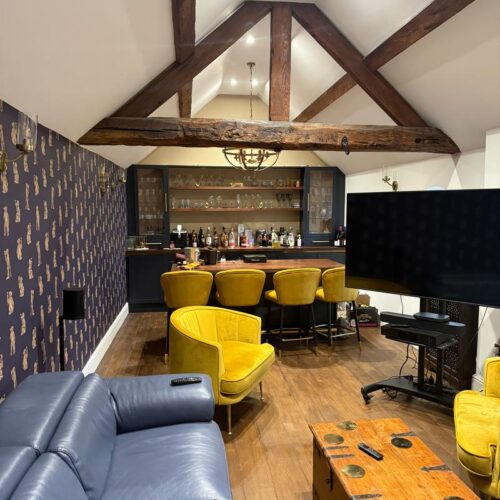
When you have a great bar room at home but nowhere to store your wine!
The client had a great home bar, which was a great place to socialise in, but they had nowhere convenient to their wine.
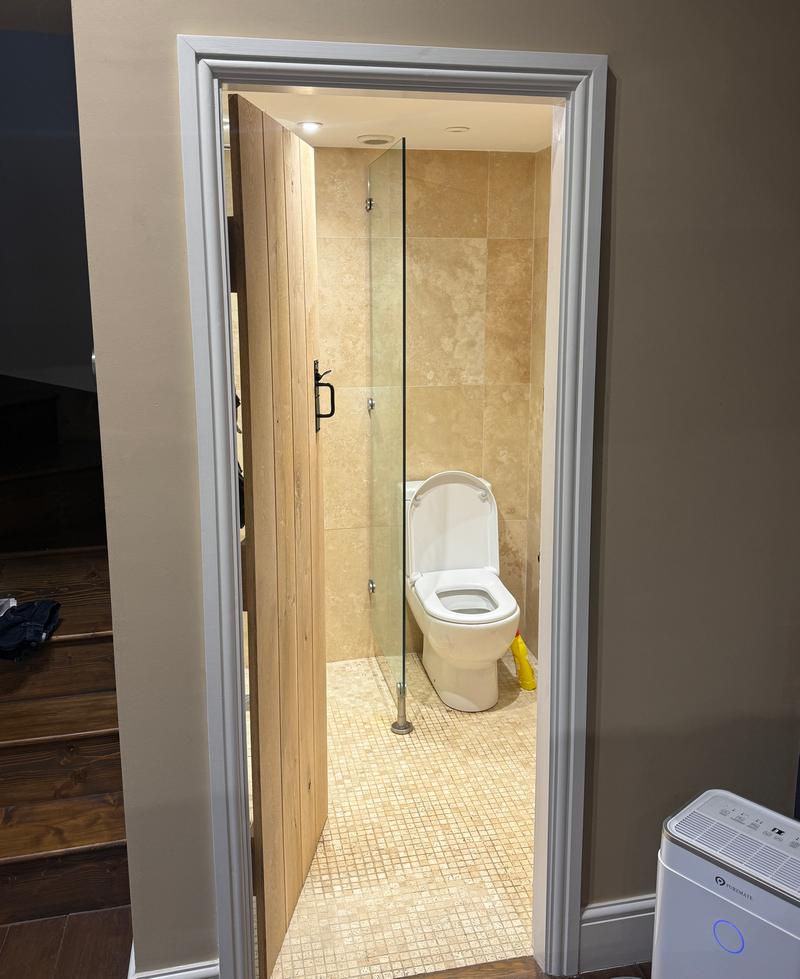
The best option was to convert was a small and underused toilet.
The project demonstrates how we transformed a redundant downstairs toilet, cupboard or similarly small room into practical and attractive bespoke wine storage.
A space that maximises wine storage, and looks great.
Can You Convert a Downstairs Toilet into a Wine Cellar?
Yes. An unused downstairs toilet can be converted into a wine room, provided the available space, access, ventilation, electrics and intended storage conditions are carefully considered.
In this project, the existing bathroom fixtures were removed and the compact room was fitted with made-to-measure solid oak wine racking, an integrated refrigerated wine cabinet, concealed LED lighting and a glazed entrance.
The room is not a fully climate-controlled cellar. Instead, the refrigerated cabinet provides controlled storage for selected bottles, while the surrounding bespoke racking provides high-capacity storage and display space.
The Project at a Glance
1.5m × 1.5m
Approximate room size
250–300
Approximate bottle capacity
Around 45
Refrigerated bottles
Solid Oak
Finished with Danish oil
Finding a Better Use for an Unwanted Room
The downstairs toilet was no longer required, but its position made it particularly suitable for a wine room. It was located directly beside the client’s home bar and entertaining area.
Rather than leaving the room unused, the client wanted to turn it into something that would complement the bar and become a visible feature of the home.
The aim was therefore not just to create storage. The room needed to feel like a deliberate part of the interior, while holding a substantial number of bottles within a very restricted footprint.
Designing Wine Storage for a 1.5-Metre Room
In a room of this size, every centimetre affects the final capacity and the ability to move around comfortably.
Conventional deep wine racking throughout the room would have narrowed the walkway. The doorway also restricted the depth of the racking that could be used near the entrance.
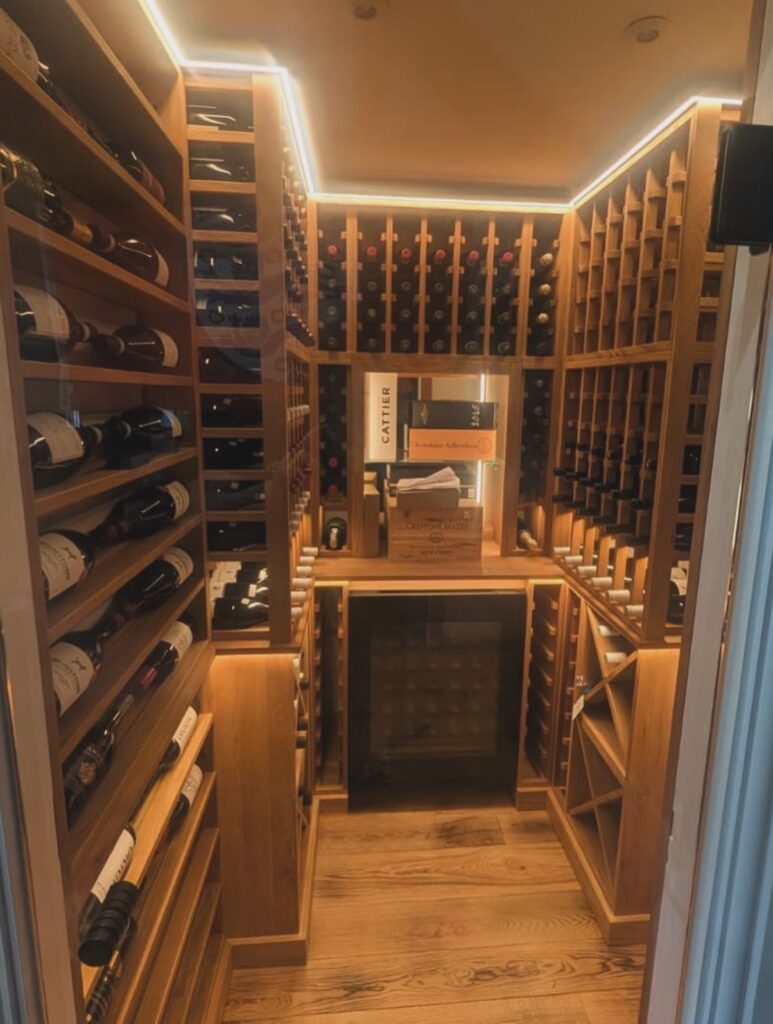
The solution was to combine several different storage formats. Slim, sideways bottle shelving was used close to the doorway, while deeper bottle compartments and display sections were positioned further inside the room.
Why Full Climate Control Was Not Used
A fully climate-controlled wine cellar was considered during the planning process. However, the limited size of the room made a specialist cooling system impractical and inefficient.
A wine cellar conditioner requires sufficient room for the unit, airflow and the discharge of heat. Incorporating this equipment would have reduced the available bottle storage and compromised the appearance of the finished installation.
The client chose to prioritise the design and usability of the room. An integrated refrigerated wine cabinet was installed instead, providing temperature-controlled storage for approximately 45 bottles.
Is this a wine room or a wine cellar?
This project is most accurately described as a bespoke wine room with integrated refrigeration. The refrigerated cabinet controls the temperature of selected bottles, but the temperature of the complete room is not mechanically regulated.
Made-to-Measure Solid Oak Racking
The complete wine-racking system was designed specifically for the room rather than assembled from standard freestanding units.
Solid oak was selected to complement the quality and character of the adjoining bar and wider interior. The timber was finished with Danish oil, which enhances the natural colour and grain of the oak.
- Made-to-measure solid oak wine racking
- Sideways bottle storage near the entrance
- Individual bottle compartments
- Display positions for selected bottles
- Wine-case and boxed-wine storage
- Integrated refrigerated wine cabinet
Smart-Controlled LED Lighting
The lighting was designed to make the room attractive when viewed from the adjoining bar as well as practical when selecting a bottle.
LED lighting was concealed around the perimeter of the room and beneath sections of the racking. The system was connected to the property’s electrical supply and integrated with the client’s smart-home controls.
A specialist local LED supplier helped ensure that the lighting components and controls were compatible with the existing home system.
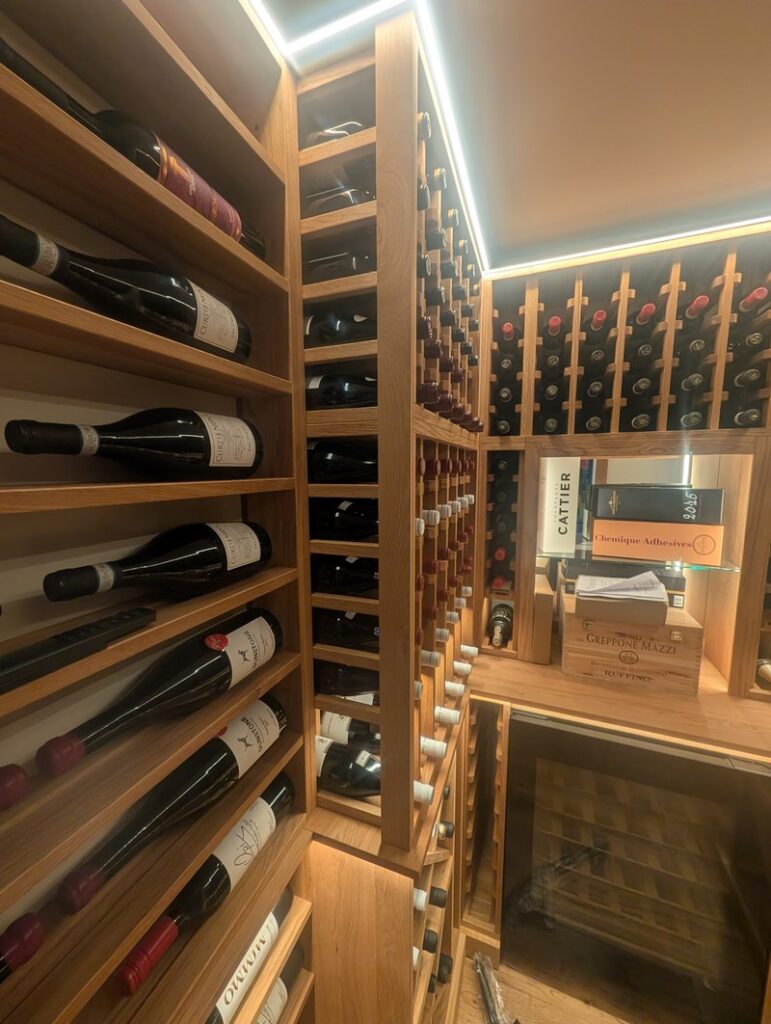
Interior photograph showing the different oak racking configurations.
Replacing the Solid Door with Glass
The original solid door would have hidden the wine room whenever it was closed. It was replaced with a frameless toughened-glass door, keeping the illuminated wine display visible from the bar.
The glass entrance also makes the small room feel more open. It creates a clear visual connection between the wine collection and the surrounding entertaining area.
This was the change that most clearly transformed the room from a converted bathroom into a deliberate feature of the home.
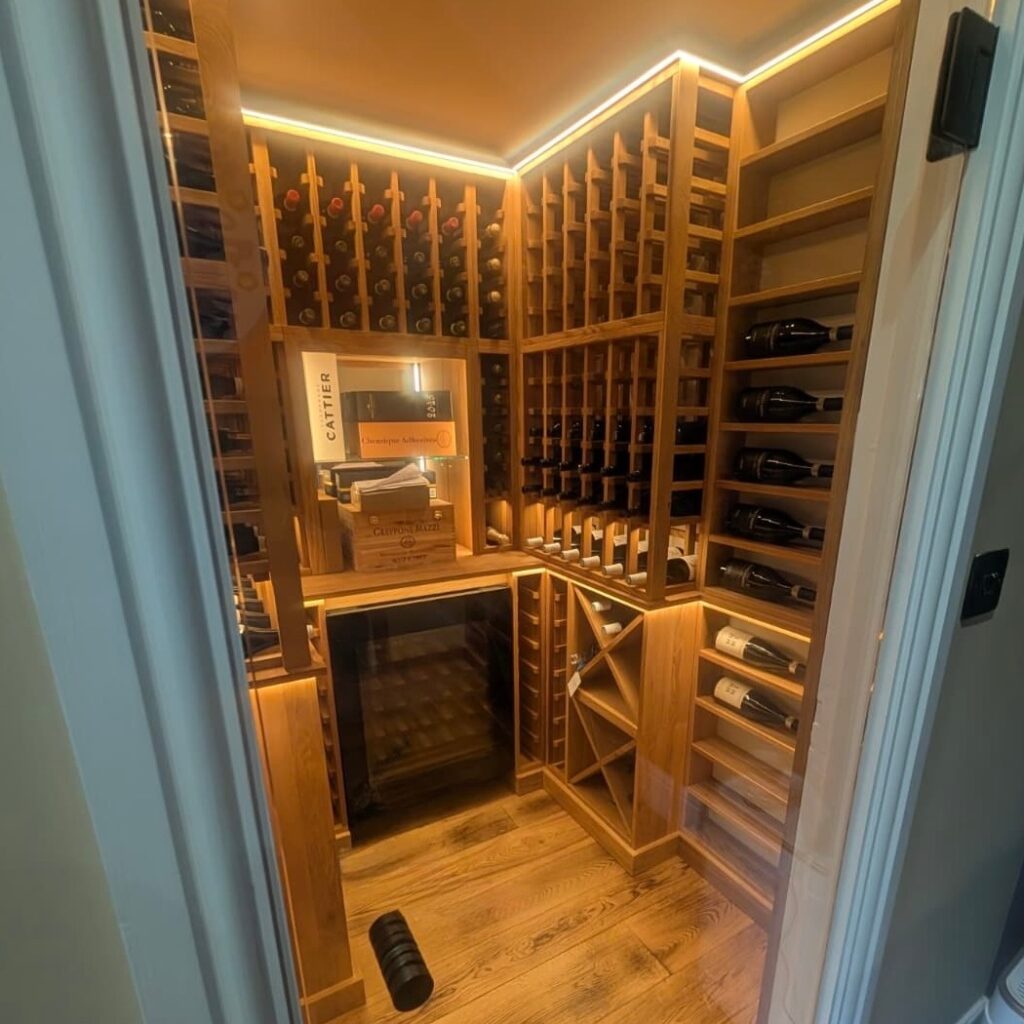
Completed wine room viewed through the frameless glass door.
How Many Bottles Does the Wine Room Hold?
The finished room accommodates approximately 250 to 300 bottles, despite having a floor area of only around 2.25 square metres.
Approximately 45 bottles can be held in the integrated refrigerated unit. The remaining capacity is distributed between horizontal storage, individual compartments, display positions and areas for boxed wine.
The exact number of bottles stored at any one time will vary according to the mixture of standard bottles, Champagne bottles, larger formats and cases.
| Original room | Unused downstairs toilet beside a home bar |
| Approximate dimensions | 1.5 metres by 1.5 metres |
| Approximate capacity | 250–300 bottles |
| Refrigerated capacity | Approximately 45 bottles |
| Racking material | Made-to-measure solid oak |
| Finish | Danish oil |
| Lighting | Concealed LED lighting with smart-home control |
| Entrance | Frameless toughened-glass door |
| Overall project period | Approximately six weeks |
| Manufacturing time | Approximately 10 days |
| Installation time | Approximately two days |
The Finished Transformation
The project took approximately six weeks to finalise. The bespoke oak racking required around 10 days to manufacture and was fitted over approximately two days on site.
The finished room now feels closely connected to the adjoining bar. The oak, Danish oil finish, warm lighting and clear glass entrance allow the conversion to complement the existing interior rather than looking like a separate installation.
Most importantly, an unused downstairs toilet has become both a practical storage room and one of the most distinctive features of the client’s entertaining space.
Frequently Asked Questions About Small Wine-Room Conversions
Can any small room be converted into a wine cellar?
Many unused rooms can be converted into wine storage, including downstairs toilets, cupboards, box rooms and spaces beneath stairs. Suitability depends on the available dimensions, access, electrical supply, ventilation and whether full-room climate control is required.
How small can a home wine room be?
There is no universal minimum size. This project used a room measuring approximately 1.5 metres by 1.5 metres. Bespoke racking can use compact spaces much more efficiently than standard freestanding wine racks.
Does a small wine room need climate control?
Not every wine room is climate controlled. The decision depends on the value of the collection, how long the bottles will be stored and the natural conditions within the room. Full climate control is different from installing a refrigerated wine cabinet.
Can a wine fridge replace full-room climate control?
A wine fridge can provide controlled storage for selected bottles, but it does not regulate the temperature or humidity of the surrounding room. In this project, the fridge was chosen because full-room cooling was impractical within the available space.
What preparation is needed when converting a downstairs toilet?
Preparation can include removing sanitaryware, isolating or altering plumbing, making good the walls and floor, installing electrical supplies and preparing the doorway. The exact work depends on the condition and existing layout of the room.
How many bottles can fit in a compact wine room?
Capacity depends on the shape of the room, racking depth, bottle orientation and the number of display features. This approximately 1.5-metre-square room holds around 250 to 300 bottles.
How long does a bespoke wine room take to make?
This project took approximately six weeks overall. The bespoke racking required around 10 days to manufacture and approximately two days to fit on site. Timings vary according to the design, preparation work and location.
Could an Unused Room in Your Home Become a Wine Room?
A downstairs toilet, cupboard, box room or space beside a home bar may offer more potential than it first appears.
Wine Racks UK designs and manufactures bespoke wine storage around the dimensions, style and practical requirements of each property.